

Stop Losing Your Yard to Florida Rain
Pinellas County gets 50+ inches of rain per year. Our sandy soil cannot hold itself together without help. If you see bare spots, washout channels, or standing water within 6 feet of your foundation, the problem is getting worse every storm.
What Erosion Control Actually Costs in Pinellas County
Most residential erosion and drainage projects in the St. Petersburg area run $2,000 to $8,000 fully installed. A simple French drain along one side of the house starts around $2,000. Full-yard regrading with multiple drain lines and discharge points runs $3,500 to $6,000. Severe slope stabilization involving retaining walls plus drainage systems can reach $8,000 or more.
The wide range reflects the reality that no two erosion problems are identical. A flat lot with standing water needs a completely different solution than a sloped lot washing soil into the neighbor's yard. That is why we start every project with a free site inspection — we need to see where the water comes from, where it wants to go, and what is standing in its way.
Waiting is the expensive option. Foundation repairs from water damage start at $10,000. Sinkhole remediation averages $25,000+. A $3,000 drain system installed today prevents a $30,000 emergency next hurricane season.
Why Florida Erosion Hits Harder Than Anywhere Else
Homeowners who moved here from clay-soil states are shocked at how fast Florida yards disappear. There are four reasons Pinellas County erosion is uniquely aggressive:
Sandy Soil Has Zero Binding Power
Florida's sandy substrate has almost no clay content. Clay acts like glue between soil particles — without it, every raindrop becomes a tiny excavator. An inch of rain on compacted clay moves almost nothing. That same inch on Pinellas sand can displace a quarter-inch of topsoil across an entire yard. Do the math over 50+ annual inches and you lose over a foot of soil every decade without intervention.
Afternoon Storms Drop 2 Inches in 30 Minutes
Florida does not rain like the Pacific Northwest with gentle steady drizzle. Our summer thunderstorms dump 1 to 3 inches in 20 to 45 minutes. That concentrated intensity overwhelms flat grades, overpowers grass root systems, and creates sheet flow that carries soil across property lines. A yard that looks fine in April can have 6-inch washout channels by September.
Flat Terrain Creates Nowhere for Water to Go
Pinellas County's average elevation is 15 feet above sea level. Many neighborhoods sit at 5 to 8 feet. Without intentional grading, water pools rather than flows. Pooling saturates the sandy subsoil, destabilizes root systems, and creates the standing-water conditions that breed mosquitoes and kill grass. Natural drainage barely exists here — every property needs engineered water management.
High Water Table Limits Absorption
Much of Pinellas County has a water table just 2 to 4 feet below grade. During the wet season (June through September), that table rises further. Soil that would normally absorb surface water cannot because it is already saturated from below. This means even moderate rains create surface runoff because the ground physically cannot take more water. Drainage systems must move water laterally, not just down.
7 Warning Signs Your Property Needs Drainage Help
Most homeowners do not call until the problem is obvious. But erosion damage is cumulative — every storm makes it worse. Here are the signs that mean you should call this week, not next year:
- Standing water 24+ hours after rain — If puddles persist overnight after a standard afternoon storm, your grade is directing water inward rather than away. The soil beneath those puddles is losing structure every day.
- Visible washout channels or ruts — These are erosion highways. Once a channel forms, every subsequent rain event deepens and widens it. A 2-inch rut in January becomes a 6-inch trench by August.
- Exposed tree roots that were buried last year — If tree roots are newly visible, the surrounding soil has eroded away. This destabilizes the tree and signals that 2 to 4 inches of topsoil have migrated off your property.
- Mulch or soil appearing on your driveway or sidewalk after rain — This is your yard literally leaving your property. It is also your soil ending up in the storm drain system, which can trigger county code enforcement notices.
- Cracks in your foundation, driveway, or pool deck — Soil movement from saturation and erosion shifts the ground beneath hardscapes. New cracks after wet season are almost always soil-related, not age-related.
- Grass dying in low spots but healthy elsewhere — Chronically saturated soil drowns grass roots by cutting off oxygen. If your yard has dead patches that always correspond to low areas, you have a drainage problem, not a grass problem.
- Neighbor's yard draining onto yours — Florida drainage law does not allow property owners to redirect natural water flow onto adjacent properties. But proving it requires documentation. We identify the source and design solutions regardless of origin.
Our Erosion Control Solutions — Matched to Your Problem
We do not sell one-size-fits-all drain kits. Every solution is engineered for your specific water source, soil conditions, lot grade, and discharge options. Here are the tools we use:
French Drains
Best for: Standing water, soggy zones, foundation-adjacent pooling
A 12 to 18-inch trench filled with washed gravel surrounding a 4-inch perforated pipe. Collects groundwater passively and redirects it to a discharge point via gravity. Works 24/7 with zero electricity and zero maintenance beyond occasional cleanout of the discharge end.
We use non-woven geotextile fabric to wrap the gravel bed, preventing sand infiltration that clogs cheap French drains within 2 to 3 years. Our drains maintain full flow for 15 to 20 years.
Typical cost: $2,000 to $4,000 per run (50 to 100 linear feet)
Yard Regrading
Best for: Water flowing toward the house instead of away, flat lots with no natural drainage
We reshape the terrain so gravity moves water away from structures and toward approved discharge points. Standard positive grade is a minimum 1-inch drop per foot for the first 6 feet from the foundation, then a gentler slope beyond.
In Pinellas County, regrading often needs to combine with drainage because our flat terrain has limited elevation change to work with. We create engineered swales — shallow vegetated channels — that move water across the property at a controlled pace.
Typical cost: $2,500 to $5,000 depending on yard size and volume of fill needed

Retaining Walls for Slope Stabilization
Best for: Properties with grade changes, hillsides losing soil, pool-to-yard transitions
Structural walls that hold soil in place against gravity and water pressure. We build with segmental concrete block (most common), natural stone, and poured concrete depending on height and aesthetic preference.
Every retaining wall we build includes a drainage aggregate layer behind the wall face and weep holes or drainage pipe at the base. A retaining wall without drainage is a dam waiting to fail — hydrostatic pressure builds behind it until something gives. Ours are designed to manage water AND hold soil.
Typical cost: $3,500 to $8,000+ depending on wall height and linear footage
Rain Gardens and Bioswales
Best for: Properties that need to absorb runoff rather than pipe it away, eco-conscious homeowners, areas where drain discharge options are limited
A rain garden is a shallow planted depression designed to collect runoff and allow it to percolate into the soil over 24 to 48 hours. Native Florida plants with deep root systems break up compacted subsoil and create natural infiltration pathways that improve each year.
We plant species like blue flag iris, canna lily, muhly grass, and coontie that tolerate both flooding and drought — essential in Florida where the same bed might be underwater Tuesday and bone-dry Friday.
Typical cost: $2,000 to $4,500 depending on size and plant selection

Dry Creek Beds
Best for: Directing surface flow while adding landscape character, replacing ugly eroded channels with intentional design
A dry creek bed uses carefully placed river rock, boulders, and native plantings to create a designated path for water flow. Unlike a bare washout channel that gets worse every storm, a dry creek bed is armor-plated — the rock absorbs the energy of flowing water and prevents further soil displacement.
These look like natural landscape features when dry and function as controlled drainage channels when wet. Many clients prefer them over buried pipe because they add visual interest and eliminate the need for discharge connections.
Typical cost: $1,500 to $3,500 per 20 to 40 linear feet

Our Erosion Control Process — How We Solve It Right the First Time
Drainage failures happen when installers skip the diagnosis. They see standing water, throw in a French drain, and leave. Two months later the problem is back — because the drain was solving the wrong problem. Our process eliminates guesswork:
Site Inspection and Water Source Identification
We visit during or immediately after rain whenever possible. We trace where water enters, where it accumulates, and where it exits (or fails to exit). We check your lot grade with a laser level, probe soil depth to hardpan, note drainage from neighboring properties, and photograph every problem area. This is free and takes 30 to 45 minutes.
Drainage Plan Design
We produce a site sketch showing existing grades, proposed modifications, drain line routes, discharge points, and any structural elements (walls, swales, creek beds). You see exactly what we will build and why before any contracts are signed. We explain trade-offs between approaches so you can make an informed decision on budget versus comprehensiveness.
Utility Location and Permit Check
We call 811 for underground utility marking (mandatory before any digging in Florida). We verify whether your specific project requires permits from Pinellas County or your municipality. Most residential French drains do not, but retaining walls over 4 feet and storm system connections always do. Any required permits are pulled before excavation.
Excavation and Installation
We schedule a dry-weather window (Florida summer requires flexibility — we watch radar daily). Trenches are dug to calculated depths and slopes. Fabric is placed, aggregate is compacted in lifts, pipe is bedded at proper grade, and the system is assembled. For retaining walls, we excavate to stable subsoil, compact a gravel base, and build the wall with drainage aggregate behind.
Testing and Grade Verification
Before we backfill, we flow-test every drain line with a hose to confirm water moves at the designed rate and discharges at the planned point. We re-check grades with a laser level to verify positive slope from foundation to discharge. If any section does not perform, we correct it before closing the trench. You do not pay for callbacks.
Restoration and Revegetation
Disturbed areas are backfilled with amended soil, re-graded to final contour, and either sodded or seeded depending on the area. Rain gardens receive their plant palette. Dry creek beds get their final stone placement and border plantings. We clean all equipment tracks and debris — your yard looks finished, not torn up.
Erosion Control Cost Guide — What Drives the Price
Understanding what affects drainage costs helps you evaluate quotes intelligently. Here is what determines whether your project is closer to $2,000 or $8,000:
| Factor | Lower Cost | Higher Cost |
|---|---|---|
| Problem Severity | Localized standing water in one area | Whole-yard sheet erosion with foundation risk |
| Soil Conditions | Clean sand, easy digging | Root-dense, rock layers, or fill debris |
| Discharge Options | Storm drain or swale within 50 feet | No nearby discharge — need dry well or long pipe run |
| Access | Open yard, equipment can reach | Narrow side yards, fenced areas, hand-dig only |
| Solution Type | French drain or regrading only | Retaining wall + drain + revegetation combined |
| Linear Footage | 30 to 50 feet single run | 100+ feet with multiple branches |
| Permits | No permits needed (most French drains) | Retaining wall or storm system connection permits |
The hidden cost of waiting: Every wet season without drainage adds to the problem. Soil loss is permanent. Foundation settling is cumulative. We have never seen an erosion problem get cheaper by ignoring it for another year. A $3,000 fix today prevents a $15,000 repair in 3 years.
Disston Heights Backyard: From Mud Pit to Usable Space in 4 Days
A homeowner in Disston Heights contacted us after their third summer dealing with a backyard that turned into an ankle-deep swamp every afternoon from June through September. Their kids could not play back there. Their dog tracked mud through the house daily. A fire pit they'd installed two years prior had sunk 3 inches into saturated soil.
The problem was threefold: the lot had negative grade toward the back fence (water pooled against the fence instead of draining away), the neighbor's property two feet higher was sheet-draining onto their yard, and the builder had apparently never installed any subsurface drainage during construction.
What We Built
- 85 linear feet of French drain along the back fence line and one side yard, collecting both their pooling water and the neighbor's runoff
- Regraded the entire backyard at 1.5% slope toward the drain system
- Installed a dry well at the low corner where no storm drain access existed within 100 feet
- Created a 6-foot-wide rain garden bed along the fence with muhly grass, blue flag iris, and coontie — absorbs overflow from extreme storms while looking intentional
- Re-sodded 800 square feet of damaged lawn with Zoysia (shade-tolerant under their mature oak)
The Result
Total project cost: $5,200. Completed in 4 working days. The first storm after completion dropped 1.8 inches — zero standing water. The fire pit area was dry enough to use that same evening. Their dog yard went from daily mud baths to clean paws. The homeowner texted us after Hurricane season: "Survived the whole summer without a single puddle. First time in 3 years."
Prevention Costs Less Than Repair — Every Single Time
We see this pattern constantly: homeowner ignores water problems for 2 to 3 years, then calls us when the damage has compounded into something 3 to 5 times more expensive to fix. Here is what delayed drainage actually costs:
Foundation Damage
Prevention: $2,500 to $4,000 (drain plus regrading near foundation)
Repair: $10,000 to $35,000 (underpinning, piering, slab leveling)
Water against a slab foundation erodes supporting soil, creating voids. The slab cracks and settles. Once it settles, you cannot just fix the drainage — you need structural repair PLUS drainage.
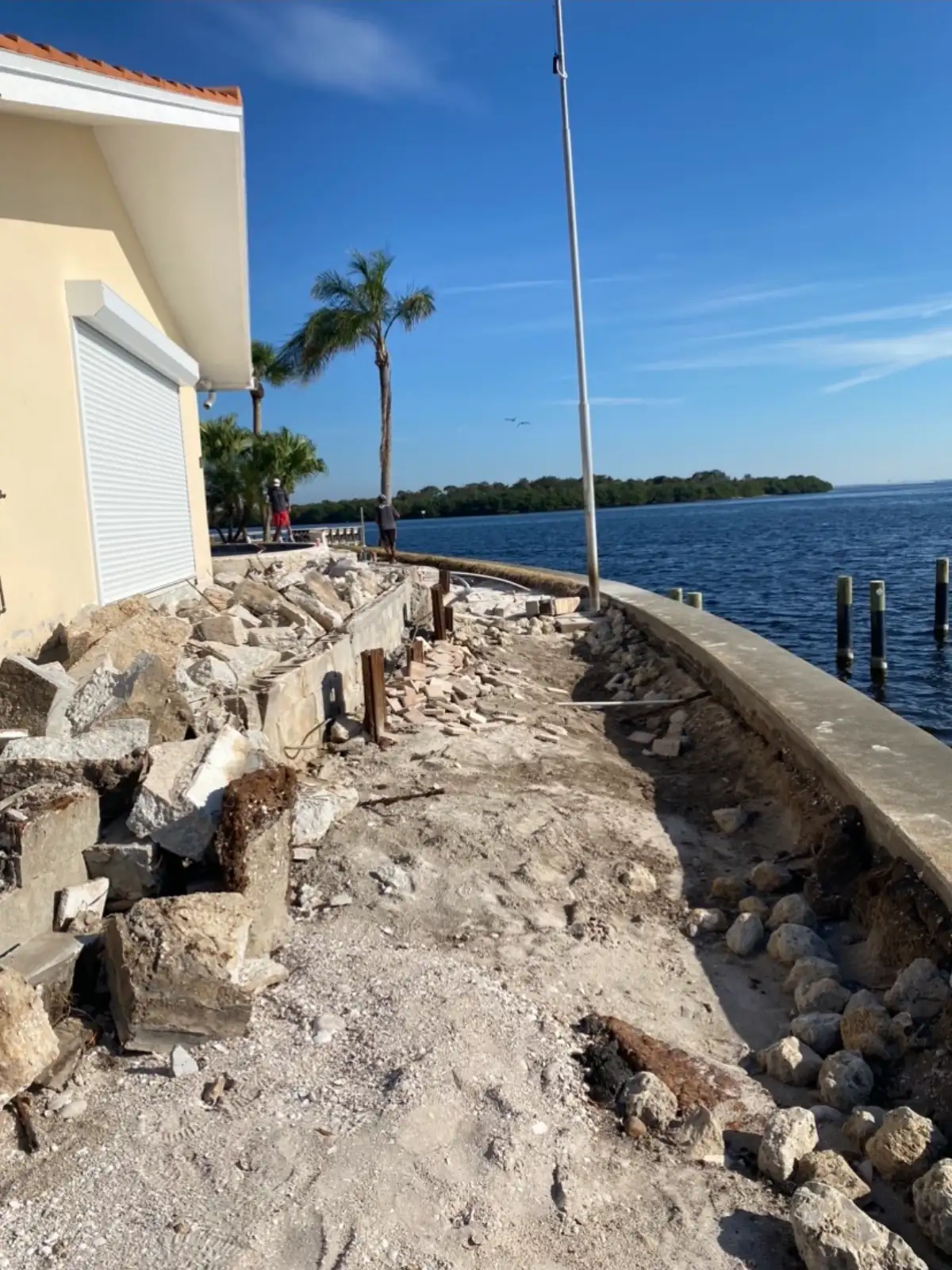
Seawall and Retaining Wall Failure
Prevention: $3,000 to $5,000 (drainage behind existing wall)
Repair: $15,000 to $50,000+ (wall replacement)
Hydrostatic pressure from trapped water behind walls is the number one cause of retaining wall failure. Installing drainage aggregate and weep holes costs a fraction of rebuilding a collapsed wall.
Sinkhole Remediation
Prevention: $2,000 to $6,000 (comprehensive drainage)
Repair: $25,000 to $100,000+ (grouting, underpinning, insurance claims)
Florida's limestone substrate dissolves when constantly saturated. Persistent water pooling accelerates subsurface void formation. Proper drainage reduces saturation time and slows karst progression.
Why Pinellas County Homeowners Trust Us With Drainage
We Diagnose Before We Dig
Other companies show up, see standing water, and quote a French drain. We show up, trace the water to its source, check your grade with a laser level, evaluate discharge options, and design a solution that fixes the cause — not just the symptom. Our callback rate on drainage projects is under 3%.
We Understand Pinellas County Soil
Our sandy soil, high water table, flat terrain, and intense seasonal rainfall create drainage challenges unique to this area. Solutions designed for clay-soil or hilly terrain fail here. We build for this specific geology because it is the only geology we work in.
We Flow-Test Before Backfilling
Every drain line is tested with water before we close the trench. We verify flow rate, confirm discharge location is clear, and document with photos. If a section does not perform to spec, we fix it while the trench is open — not after you call back in six months.
We Combine Hardscape and Landscape Solutions
Drainage is not just pipes. The best erosion control combines engineered drainage with strategic planting. We handle both in a single contract — you do not need to hire a drainage company, wait for them to finish, then hire a landscaper to fix what they tore up.
Erosion Control Questions — Answered
Erosion control in the St. Petersburg area runs $2,000 to $8,000 depending on severity. A basic French drain install on a flat lot runs $2,000 to $3,500. Full-yard regrading with drainage runs $3,500 to $6,000. Severe slope stabilization with retaining walls and multiple drain systems can reach $8,000 or more. We provide a free site inspection and written quote before any work begins.
Florida's 50 to 55 inches of annual rainfall is the primary cause. Sandy soil has almost no binding capacity, so it moves the moment water hits it. Other contributors include poor lot grading that directs water toward the house, missing or clogged gutters dumping concentrated flow, neighbor properties draining onto yours, tree root removal that destabilized soil, and irrigation over-watering that saturates the ground between rain events.
A French drain is a gravel-filled trench with a perforated pipe that collects groundwater and redirects it away from problem areas. Water enters through the gravel, flows into the perforated pipe, and gravity carries it to a discharge point — typically a storm drain, swale, or dry well. In Pinellas County, French drains are the most common fix for standing water, soggy spots, and foundation-threatening pooling because our flat terrain makes surface grading alone insufficient.
Most residential drainage projects take 2 to 4 days from excavation to final grading and cleanup. A simple French drain along one side of the house is typically a 1 to 2 day job. Full-yard regrading with multiple drain lines takes 3 to 4 days. Complex projects involving retaining walls combined with drainage may run 5 to 7 days. We always schedule a rain-free window for excavation work.
In most cases, yes. French drains solve about 80 percent of residential flooding issues in Pinellas County. However, some situations require additional measures. If your yard sits lower than surrounding properties, you may need a sump pump or raised berm in addition to the drain. If the flooding is caused by a high water table rather than surface runoff, a French drain alone may not be enough. We always diagnose the actual water source before recommending a solution.
Most residential drainage projects in unincorporated Pinellas County do not require a permit if they stay within your property lines and discharge to an approved point. However, any work that connects to the municipal storm system, alters drainage that affects neighboring properties, or involves retaining walls over 4 feet does require permits. We handle all permit research and applications as part of our service — it is included in the quoted price.
A swale is a shallow, vegetated channel that moves surface water across the landscape using gravity and natural grade. A French drain is a buried system that collects subsurface water through a perforated pipe in a gravel bed. Swales work great for directing large volumes of rain runoff across open areas. French drains excel at pulling trapped water out of saturated soil near foundations, fence lines, and low spots where surface flow cannot reach. Many projects use both together for complete water management.
Absolutely. Strategic planting is one of the most effective long-term erosion controls. Deep-rooted native plants like muhly grass, coontie, and Simpson stopper bind sandy Florida soil. Ground covers like perennial peanut and sunshine mimosa create living mats that prevent rain splash erosion. Rain gardens use native plants in shallow depressions to absorb runoff that would otherwise carry soil away. We combine hardscape drainage with strategic planting for solutions that improve with age rather than degrade.
Every Storm Makes It Worse. Let Us Fix It Before the Next One.
Free site inspections. Written quotes. No pressure. We will show you exactly where your water comes from, where it needs to go, and what it costs to get it there.
Related Services
Retaining Walls
Structural walls that hold slopes, terrace grades, and create usable space from unusable hillsides. Every wall includes proper drainage.
Learn More →
Water Management
Smart controllers, rain sensors, and drip conversion that prevent over-watering — the hidden cause of many erosion problems between rain events.
Learn More →
Landscape Design
Full design-to-install service. Florida-native plants with deep root systems that bind soil and absorb runoff while looking beautiful year-round.
Learn More →